Sign up now to join the JEGS email newsletter and be the first to learn about new products, special deals and e-mail only offers!

 31 People Found This Article Helpful


If you are serious about engine performance, you will eventually need to understand camshaft specifications. The camshaft plays a major role in how an engine makes power, how it idles, and where in the rpm range it performs best. Knowing how to read camshaft specs allows you to choose the right cam for your build and avoid common mistakes that hurt performance.
In this guide, we explain what a camshaft does, break down the most important camshaft specs, and walk through how to read a camshaft timing card with confidence.
If you are shopping for a factory replacement or a performance upgrade, the experts at JEGS are ready to help. With a huge selection of camshafts and engine components, JEGS makes it easy to find parts that work together and deliver results.

An engine produces power by drawing in air and fuel, compressing it, igniting it, and expelling exhaust gases. For this process to happen efficiently, the intake and exhaust valves must open and close at precise times.
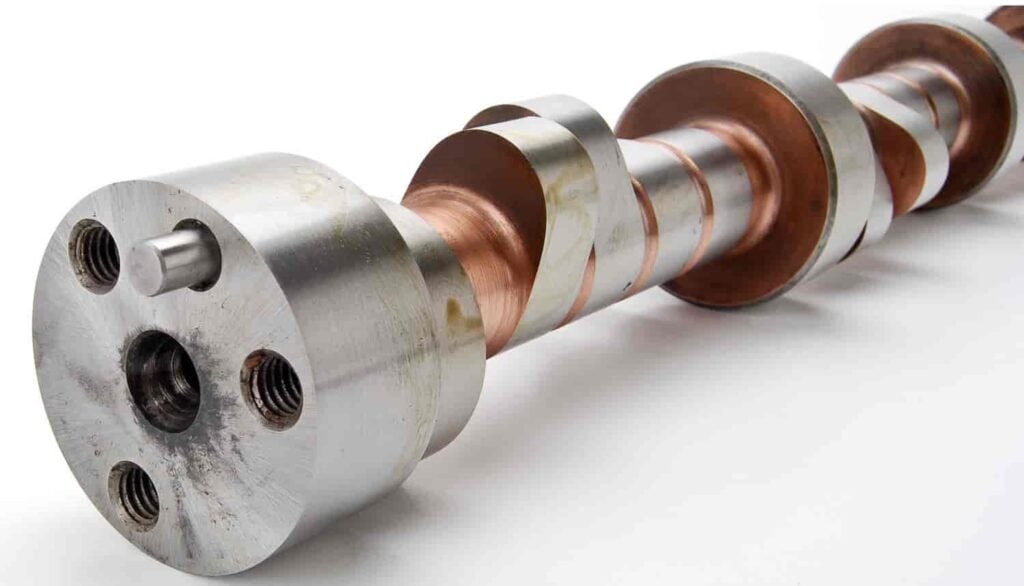
The camshaft controls this process. It is a rotating shaft with shaped lobes that push on lifters, pushrods, and rocker arms, or directly on the valves in overhead cam engines. As the camshaft rotates, it opens and closes each valve according to its design.
Engine layouts vary:
• Pushrod engines use a camshaft in the engine block
• Single overhead cam engines use one camshaft per cylinder head
• Dual overhead cam engines use separate intake and exhaust camshafts
Modern engines often use variable valve timing systems that adjust cam timing to improve power, fuel economy, and emissions across different rpm ranges.
Because the camshaft controls valve motion, it has a direct impact on horsepower, torque curve, idle quality, and drivability. Incorrect cam timing or cam selection can lead to poor performance or serious engine damage, especially in interference engines where valves and pistons share the same space at different times.
Sign up now to join the JEGS email newsletter and be the first to learn about new products, special deals and e-mail only offers!
Before diving into camshaft specs, it helps to define your goals.
Ask yourself:
• Is this a daily driver, weekend cruiser, tow vehicle, or race car
• What rpm range will the engine spend most of its time in
• What compression ratio and cylinder heads are being used
• What transmission and gearing are in the vehicle
A camshaft must match the entire combination. Even the best cam will disappoint if the rest of the engine cannot support it.
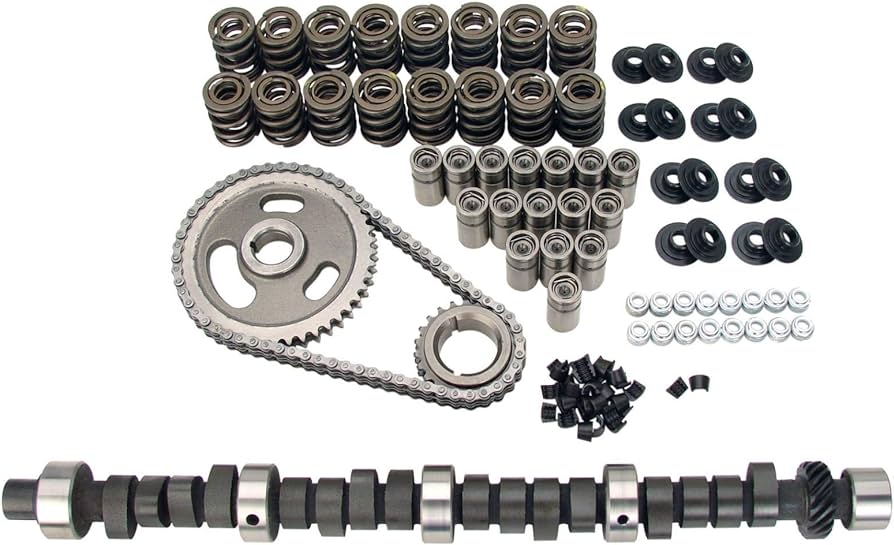
A camshaft timing card, often called a cam card, is included with most aftermarket camshafts. It lists all the specifications needed to install and degree the camshaft correctly.
The cam card tells you exactly how the cam was designed to operate. Following it ensures proper valve timing, correct installation, and maximum performance.
Understanding camshaft specs becomes straightforward once you know what each value represents.
Lobe lift is the amount of lift ground into the camshaft lobe itself. It shows how far the cam lobe moves the lifter.
Lobe lift does not represent actual valve lift.
Rocker arm ratio multiplies lobe lift to produce valve lift. For example, a cam with .400 inches of lobe lift and a 1.5 to 1 rocker ratio results in .600 inches of valve lift.
Gross valve lift is the final lift number the valve sees and is one of the most important clearance related specs.
Duration describes how long a valve stays open, measured in degrees of rotation.
Advertised duration is measured at a very small amount of lift and varies by manufacturer, which makes it less useful for comparison.
Duration at .050 inches of lift is the industry standard for comparing cams. It represents the number of crankshaft degrees the valve is open once lift reaches .050 inches.
Shorter duration favors low rpm torque and smooth idle. Longer duration improves high rpm power but reduces low speed response.
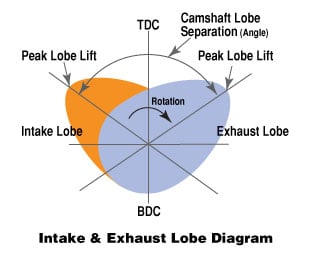
The lobe centerline is the point of maximum lift for either the intake or exhaust lobe, expressed in degrees. Intake centerline is most commonly used during cam degreeing.
Lobe separation angle is the number of degrees between the intake and exhaust lobe centerlines.
Tighter lobe separation increases overlap, which improves mid range power but roughens idle. Wider lobe separation smooths idle and improves vacuum.
Cam advance shows how many degrees the intake lobe is advanced relative to its centerline. Advancing a cam typically improves low rpm performance and throttle response.
Mechanical or solid camshafts require valve lash, which is the clearance between the rocker arm and valve tip at operating temperature. This spec is listed on cam cards for solid flat tappet and solid roller camshafts.
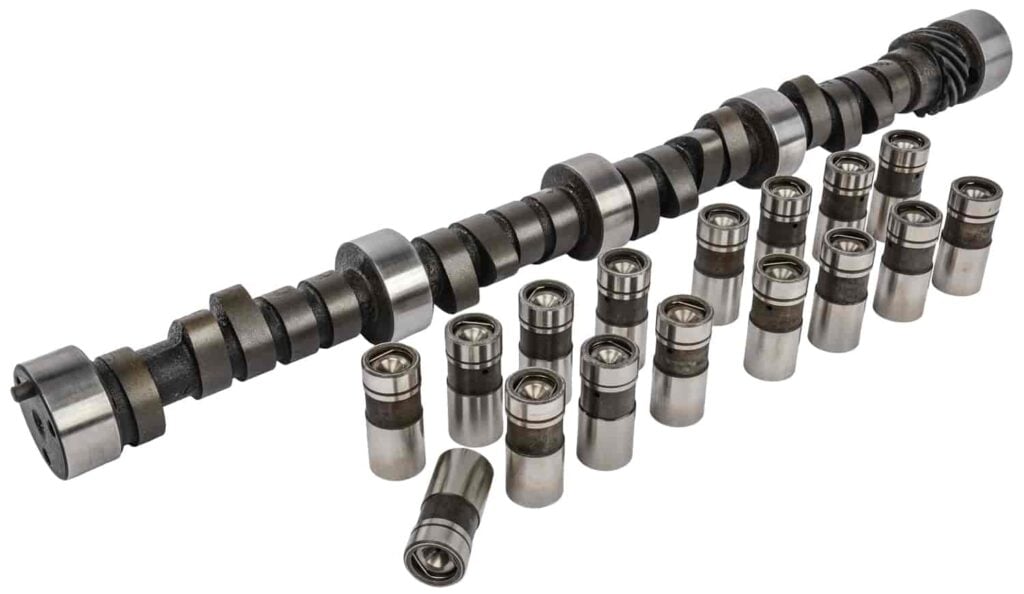
Each camshaft spec works together to shape how the engine behaves.
• Lift affects airflow and potential horsepower
• Duration determines where the engine makes power
• Lobe separation influences idle quality and vacuum
• Advance fine tunes low rpm response
Understanding these relationships helps you choose a camshaft that matches your engine and driving style instead of fighting against it.
| Camshaft Type | Distributor Gear |
|---|---|
| Cast Iron Hydraulic or Solid Flat Tappet Cam | Cast Iron Gear Composite Gear |
| Austempered Ductile Iron Hydraulic or Solid Roller or Nitrided Cam | Melonized / Hardened Steel Gear Composite Gear |
| Billet Steel Hydraulic or Solid Roller Cam | Bronze Gear Composite Gear |

Many performance issues come from misinterpreting camshaft specs.
Common mistakes include:
• Choosing based on peak horsepower numbers alone
• Ignoring compression ratio and cylinder head airflow
• Overlooking valve spring requirements
• Selecting a cam designed for higher rpm than the vehicle uses
Reading the cam card carefully and matching specs to your application prevents these problems.

JEGS offers a wide selection of camshafts from trusted brands including Comp Cams, Edelbrock, Chevrolet Performance, Ford Performance, Mopar Performance, Lunati, Crower, and the JEGS house brand. Whether you are replacing a worn cam or building a high performance engine, JEGS has the parts and expertise to help you succeed.
Visit www.jegs.com to compare camshaft specs, explore supporting components, and get expert help choosing the right cam for your engine.

Before I make a very expensive buy please help me understand can cards I have a 1970 388 SBC running a 219 227 @ 50 adv 262-268 lift 468 489 ls is 112 this is a flat tappet cam thinking about changing to a hyd roller retrofit cam @ 50 231-235 adv 284-288 lift 510-530 center line 108 ls 112
Heres my question will the new cam give at least 30 hp and torque also the motor has alum heads with a lot of work done to them and 10.5 compression . Also do you know how long new pushrods would be

Rick, you are reading the cam card the right way, and the big thing to focus on is that your new hydraulic roller option has more duration at .050 and more valve lift than what you have now. On a healthy 388 with worked aluminum heads and 10.5 compression, that kind of step usually can pick up power, but I cannot promise a guaranteed 30 hp and 30 lb ft gain without knowing the rest of the combo and where the engine is currently making power. Intake manifold style, carb size, header size, exhaust, converter and gearing, and especially the current heads flow numbers and rpm range all decide whether that extra duration and lift turns into a real gain or just moves the power higher. The 108 intake centerline with a 112 LSA also suggests the cam is installed advanced and will act a little stronger in the midrange than if it were straight up, but again, the results depend on the full combination and how it is tuned. On pushrod length, nobody can give an accurate number from the cam card alone. A retrofit hydraulic roller can change base circle, lifter style, and required preload, and your heads may have been milled, block may be decked, and you might have different rocker arm geometry, all of which changes pushrod length. The correct way is to use an adjustable checking pushrod and verify rocker tip sweep on the valve, then order the length that matches your geometry. If you want, our tech specialists can walk you through picking a cam that fits your exact goals and make sure you get the right valvetrain parts to match, so you do not spend money twice. Call us at 1-800-345-4545 and ask for a tech specialist.

Trying to figure out what cam I got numbers on cam 112853 and271402 supposed to be a small block Ford cam
Hi Gracie,
To identify your camshaft based on the numbers 112853 and 271402, we’ll need to cross-reference those numbers with camshaft manufacturer catalogs. Here’s some insight to help you figure it out:
Most camshafts have identifying numbers stamped into the cam, but they’re often specific to the manufacturer. Common manufacturers for small block Ford cams include Comp Cams, Lunati, Crane Cams, and Ford Racing.
The numbers 112853 and 271402 don’t directly match standard part numbers in some common catalogs, which suggests they may be casting numbers.
If the part numbers alone don’t lead to identification, you can measure the cam’s key specifications:
Lobe lift: Use a dial indicator to measure the lift of the cam lobes.
Duration and Lobe Separation Angle (LSA): If you have access to a degree wheel, you can measure these specs to match the cam to known profiles.
Look for Other Markings:
Some cams have additional branding (e.g., initials or logos like “CC” for Comp Cams, or “FR” for Ford Racing) stamped near the distributor gear or rear journal.
Contact the Manufacturer:
If no other markings help identify the cam, you can reach out to potential manufacturers with the numbers 112853 and 271402. They may be able to identify the camshaft based on casting or part numbers in their internal records.
Common Small Block Ford Camshaft Brands
If the camshaft is supposed to be for a small block Ford, it might belong to one of the following:
Comp Cams: Known for their performance-oriented grinds; check their High Energy, Magnum, or Xtreme Energy series.
Ford Racing: Often uses specific codes tied to production vehicles or aftermarket upgrades.
Crane Cams or Lunati: Both offer a wide range of cams for small block Fords.
If you need further assistance identifying your cam, feel free to reach out to us at 1-800-345-4545 and speak to a JEGS tech support specialist. We’ll help get you pointed in the right direction!

Hello how do I get a cam card
Hello Terry,
To get a cam card you need to contact the manufacturer of your camshaft. If you need help, we are open 7 am-Midnight EST Monday through Friday and 8:00 am-11:00 pm on Saturday and Sunday. Call us at 1-800-345-4545.

On dyno car goes lean at 5000 rpm. 523 ford 1450 carb A2000 Aeromotive fuel pump and regulator, an 10 line to two an 8 at carb. different carb, 1050 dominator , same result. fuel pressures changed and reset , jets changed, same result, at 5000 goes lean. checked valve pressures. help if you can. thank you.
Larry, It sounds like you’re experiencing a consistent fuel delivery issue at 5000 RPM, which persists even after making multiple adjustments to fuel pressure, jets, and carbs. Given that you’ve already changed out the carburetor and fuel pressure settings, and you’re still seeing the same lean condition, it may indicate a restriction in fuel delivery or a supply issue.
Here are a few things you might want to check:
Fuel System Capacity: Ensure your fuel pump and regulator can support the fuel demands of your engine at high RPM. While the Aeromotive A2000 should be more than capable, check the flow rate at the desired pressure to make sure the fuel pump is delivering enough fuel under load. Even a small drop in pressure at high RPM can cause a lean condition.
Fuel Lines: While you’re using an AN-10 line to feed two AN-8 lines at the carb, confirm that the fuel lines aren’t experiencing any kinks, sharp bends, or obstructions that could reduce flow.
Fuel Filters: Check that your fuel filter is not clogged. A restricted filter can limit the amount of fuel reaching the carb at higher RPMs, causing a lean condition.
Fuel Pressure Regulator: Make sure the regulator is functioning properly, and it maintains the desired fuel pressure throughout the RPM range. Consider testing it for stability at higher RPMs to rule out any drop-off.
Ventilation Issues: Inspect your fuel tank’s vent to ensure it’s properly ventilated. A tank that isn’t venting properly can create a vacuum, which can restrict fuel flow and cause lean conditions at higher RPMs.
Electrical Issue: Sometimes, electrical issues with the fuel pump wiring (voltage drops or poor grounds) can cause intermittent fuel supply problems at high RPMs.
Since you’ve already taken several steps and are still encountering issues, it might be a good idea to get some professional advice from JEGS. Feel free to reach out to our tech support team at 1-800-345-4545. They’re available from 7 am to midnight EST Monday through Friday and 8:00 am-11:00 pm on weekends, and they can help troubleshoot this further.



Leave a Reply