Sign up now to join the JEGS email newsletter and be the first to learn about new products, special deals and e-mail only offers!

 217 People Found This Article Helpful


Transmission coolers play an important role in preventing failure and overheating. Whether you have a high-performance vehicle or frequently tow heavy loads, a transmission cooler is a critical component in ensuring the longevity and reliability of your vehicle's transmission. In this article, we'll discuss the different types of transmission coolers available and how to choose the right size and temperature for your specific needs.
A transmission cooler either built into the radiator ("radiator transmission cooler") or typically mounted in front of it is designed to cool the transmission fluid. The transmission fluid is responsible for lubricating and cooling the transmission components, and when it overheats, it can cause damage. The transmission cooler also helps maintain a consistent temperature by dissipating the heat generated by the transmission fluid as it flows through the cooler.
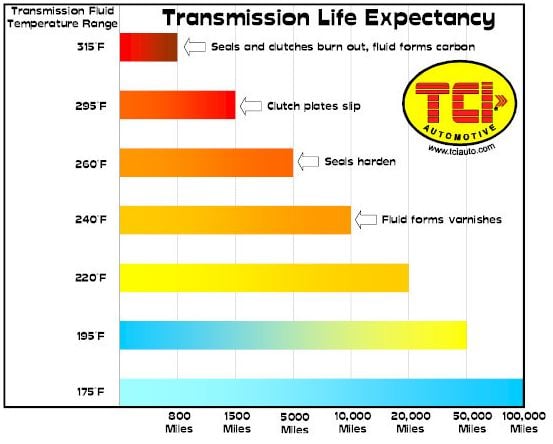
The ideal transmission temperature is between 160°F and 200°F. Any higher than that, and the fluid can start to break down and cause damage to the transmission. However, in extreme situations like towing heavy loads or racing, the temperature can exceed the ideal range. This is where a transmission cooler comes in handy as it can help reduce the temperature and prevent damage to the transmission. Below is a very helpful transmission fluid temperature chart from TCI Automotive showing the effects of transmission fluid temperature on transmission components.
Sign up now to join the JEGS email newsletter and be the first to learn about new products, special deals and e-mail only offers!
There are three main types of transmission coolers: stacked plate, tube and fin, and plate and fin. Each type has its own advantages and disadvantages, and the best transmission cooler for you will depend on your specific needs.
Stacked plate transmission coolers are the most efficient and effective type of cooler. They have a series of plates stacked on top of each other, and the transmission fluid flows through the small passages between the plates. This design provides a large surface area for the heat to dissipate, making it very efficient. They are also very durable and can handle high flow rates.


Tube and fin transmission coolers are the most common type of cooler. They have a series of tubes with fins attached, and the transmission fluid flows through the tubes while the fins dissipate the heat. They are less expensive than stacked plate coolers but are not as efficient.
Plate and fin transmission coolers are similar to tube and fin coolers, but they have plates instead of tubes. The plates have small fins on them, and the transmission fluid flows through the passages between the plates. They are more efficient than tube and fin coolers but not as efficient as stacked plate coolers.

Choosing the right size of transmission cooler is important to ensure that it can handle the amount of heat generated by your transmission. The general rule of thumb is to choose a cooler that has an advertised GVW rating at least three times the weight (number) of your vehicle or the weight of the trailer you are towing. For example, if your vehicle weighs 5,000 lbs. the advertised GVW size of the cooler should be at least 15,000. You should also consider the type of transmission you have and the amount of driving you do.
A transmission cooler is a critical component in maintaining the longevity and reliability of your vehicle's transmission. Choosing the best transmission cooler for your specific needs will depend on the type of driving you do and the weight of your vehicle or trailer. Stacked plate coolers are the most efficient, but tube and fin and plate and fin coolers are also effective and less expensive. Always ensure that the cooler you choose is rated for at least three times the weight of your vehicle or trailer and can handle the amount of heat generated by your transmission.


1986 K10 Chevy PU, sb 383 Blueprint crate motor, 700r4 rebuilt trans (1750 stall), and Cold Case radiator GMT556AK. Was planning on bypassing the trans cooler in the radiator and plumbing directly to a Jegs High Performance Transmission Cooler (22,000 or 26,000 GVW) mounted directly in front of the radiator.
Is the stand alone cooler enough capacity for this set up? Or would you suggest a different plan?
Thanks in advance.

Justin, a stand-alone transmission cooler can work with your 700R4, but for a 383-powered pickup I would lean toward the larger 26,000 GVW cooler rather than the 22,000 GVW version. A stacked-plate style cooler mounted directly in front of the radiator with good airflow is the better choice for controlling heat. Since you are bypassing the radiator entirely, adding a transmission temperature gauge is strongly recommended so you can confirm the cooler is keeping fluid temperature in a safe range. The 1750 stall converter should not create excessive heat by itself, but vehicle weight, gearing, traffic, and driving style all affect cooling needs. Make sure the cooler lines and fittings are properly sized and avoid sharp bends or restrictions. For cold-weather use, a thermostatic bypass can help prevent the fluid from staying too cool. If the truck will see towing, repeated hard acceleration, or a lot of slow traffic, stepping up to an even larger stacked-plate cooler would provide additional protection. Give us a call at 1-800-345-4545 and speak with a Tech Specialist to confirm the best cooler size and line setup for your combination.

Recommended size for zf6 manual that’s in a 2001 f250 with a 7.3. Radiator I’m getting doesn’t have the internal cooler like the stick radiator. Would 7-8 rows or about 20” x 7” be sufficient?
Steven, since your truck has the ZF6 manual transmission, you do not need a transmission cooler. The internal cooler in the factory radiator is only used on automatic transmission models, so if you’re replacing the radiator on a manual transmission truck, the lack of an internal transmission cooler is not a concern.
If you’re referring to adding an external cooler for another component, such as the power steering system, that’s a different discussion. But for the ZF6 itself, the transmission is lubricated by its own gear oil and is air cooled through the transmission case and there is no transmission pump to push fluid through the transmission or to a cooler. It does not circulate fluid through the radiator.
So, there is no need to install a 7 or 8 row, 20 inch by 7 inch transmission cooler for your manual transmission. As long as the replacement radiator provides adequate engine cooling for your 7.3L Power Stroke, you should be in good shape.
If you have questions about the replacement radiator or any other cooling system upgrades for your truck, give us a call at 1-800-345-4545 and a Tech Specialist can help you choose the right components.

1955 Chevy 210, ls3, 4L65E trans, Cold Case radiator CHT56355LSK no trans cooler in radiator. Looking at Derale 13740 for primary cooler. Also adding inline temp gauge and cooler fan switch 190 On—175 Off. 37,000 btu an hour heat rejection.
Thoughts??
Hi John, your setup sounds well thought out, and you’re definitely heading in the right direction with that combination. The LS3 paired with a 4L65E can make a fair bit of heat in the transmission, especially if you’re doing highway driving or any spirited use, so having a dedicated cooler is a smart move.
The Derale 13740 is an excellent choice for what you’re describing. At 37,000 BTU/hr of heat rejection and with its integrated fan, it’s more than capable of keeping transmission temperatures under control in a setup like yours. Since your Cold Case radiator doesn’t have an internal cooler, using that Derale unit as the primary and only transmission cooler is completely fine.
Your fan switch activation points also make sense. Turning on at 190°F and off at 175°F gives you a good safety buffer which will keep your trans fluid right around the sweet spot, under 200°F most of the time. Mounting location will matter, though; make sure it’s getting clean airflow if possible, or at least isn’t tucked too close to a heat source like headers.
The inline temperature gauge is a great addition, too. It’ll let you keep an eye on real-world temps and confirm the system’s working as expected. The only thing to double-check is your line routing, just make sure you’re using proper high-pressure transmission cooler hose or hard line rated for ATF, and route it so it won’t chafe or overheat.
Overall, that Derale cooler setup should serve you perfectly for your LS3/4L65E combo in the ’55 Chevy. If you’d like, one of our tech specialists can confirm ideal placement or discuss a comparable setup in another brand. You can reach them at 1-800-345-4545, and they’ll be glad to go over all the small details to make sure everything runs reliably.

I have a 1969 Chevelle with a GVW of 3230 lbs. . I have a 496 bbc stroker with a 700 r4 transmission . What transmission cooler do you recomend for me and does Jegs have them ?
Hi Tony, thanks for the details on your Chevelle. With a 496 big block stroker and a 700R4, you’re definitely putting some serious torque and heat through that transmission, so a quality cooler is a smart choice.
For your setup, I’d recommend going with a stacked-plate or heavy-duty plate-and-fin style cooler. These designs are far more efficient than the older tube-and-fin style and can shed a lot more heat, which is important when you’re dealing with the higher horsepower and load of a stroker engine. Something in the larger range, usually 20,000 to 30,000 GVW rating, would be a good match since you’ll want extra insurance against overheating, especially during spirited driving or if the car ever sees highway cruising in overdrive.
Yes, JEGS carries transmission coolers from several trusted brands that fit what you need, including heavy-duty stacked-plate series coolers that work great in high-performance street cars like yours. You’ll just want to confirm your mounting space in front of the radiator or condenser so you can select the right dimensions.
If you want to narrow down the best fit for your Chevelle, give us a call at 1-800-345-4545 and one of our tech specialists can match you up with the right size cooler and make sure you get everything you need for a smooth install.

I want to check on size and price of an automatic transmission cooler for a 2002 Miata .
Hi Scott, for your 2002 Miata with an automatic transmission, you’ll want to size a cooler based on both engine size and how you use the car. Since the Miata’s transmission is relatively small compared to trucks or SUVs, you don’t need one of the really large units meant for heavy towing. A compact plate-and-fin style cooler from a brand like B&M or Derale is a good match because these offer efficient cooling in a small package.
For pricing, most of the smaller to mid-size coolers for applications like yours typically run between about $60 and $150, depending on brand, design, and whether you choose one with an installation kit included. Mounting it in front of the radiator or A/C condenser is common to get maximum airflow.
One other note: if you’re using the Miata for spirited driving or track days, it’s worth leaning toward the higher-capacity side of that range to keep temps stable. For just daily driving and some highway use, the compact styles will be plenty.
To match the best option for your exact setup, it would help to confirm whether you want this as an add-on to the factory cooler in the radiator or as a standalone upgrade. For that detail, I recommend calling us at 1-800-345-4545 and a JEGS tech specialist can walk you through the best size and price options available for your Miata.

I have a 1995 Dodge Ram 2500 4×4 with the 5.9 Cummins and 47RH transmission. I am having the transmission rebuilt, and replacing all the cooling lines along with the cooler located up front of the radiator. I want to bypass the other cooler that is located on the passenger side under the exhaust manifold. Which cooler would you recommend to use? The vehicle GVWR is 8800.
Hey Garrett,
Sounds like you’re doing things right by upgrading the cooling system while rebuilding the transmission. For your 1995 Ram 2500 with the 5.9 Cummins and 47RH, bypassing that heat exchanger under the manifold is a common move. A good quality plate-style transmission cooler mounted in front of the radiator will do a much better job keeping temps in check, especially under load.
We’d suggest going with something like a Derale Hyper-Cool remote mount cooler with a fan if you do a lot of heavy towing or off-road driving. With your 8800 GVWR, you’ll want a cooler rated for at least 30,000–40,000 GVWR to give you solid heat control and protect your rebuild. Just make sure your cooler has at least 1/2-inch NPT or AN-style fittings for flow and durability.
If you’re replacing the lines, running -6 or -8 AN braided lines with proper fittings will really finish off the install right and give you long-term reliability.
If you want help picking out the exact cooler and fittings you need, give us a shout at 1-800-345-4545 and talk to one of our tech specialists. We’re happy to help you dial it in.

Can you recommend a tranny cooler for a 2012 Jeep Grand Cherokee 3.6 ltr 5 speed automatic. Live in northeast Ohio where temp ranges from 0 – 95 degrees
Hi Gary, thanks for your question! For your 2012 Jeep Grand Cherokee with the 3.6L engine and 5-speed automatic transmission, a plate-and-fin style transmission cooler is a great upgrade, especially given the wide temperature range in Northeast Ohio.
We recommend looking at a medium to large plate-and-fin cooler, such as the Derale Series 7000 or 8000 or B&M SuperCooler. These coolers are efficient, durable, and handle both cold starts and summer heat well. A model around 11″ x 7″ x 0.75″ to 1.5″ thick would be a solid choice for your vehicle and climate.
Make sure to mount the cooler in front of the radiator or A/C condenser for best airflow. If you tow, drive in hilly areas, or see higher temps in summer traffic, this added cooling can significantly extend your transmission’s life. Also, keep in mind you may need adapter fittings to work with your transmission lines and radiator.
If you need help selecting the exact model or install hardware, contact us at 1-800-345-4545 and speak to a JEGS tech support specialist. We’re happy to help get you set up right!

Hi, I am looking to buy a Hayden either model 677 or 678 for my Mercedes E250 , W212, which Hayden model is best suited for my car, a daily runner also stuck in traffic jams and without towing. Please advise and recommend. Thanks in advance.
Hello Steven.
Thanks for your questions! For your Mercedes SLK 200 Kompressor (R171), which is a lightweight weekend car with no towing, a Hayden transmission cooler that supports light to moderate use, such as the Hayden 676 or 677, would be well-suited. These models offer reliable cooling performance without being oversized, helping maintain stable transmission temperatures during spirited weekend drives. The Hayden 677, in particular, is a compact plate-and-fin cooler that provides efficient cooling in tight spaces—ideal for a car like your SLK.
For your Mercedes E250 W212, which is a daily driver frequently in stop-and-go traffic, the Hayden 678 is the better choice between the two you’re considering. It offers more cooling capacity than the 677, making it better suited for urban driving conditions where heat buildup is more common, especially without the benefit of constant airflow. The 678 will help maintain healthy transmission temperatures and extend transmission life under the demands of regular commuting.
If you need help with installation guidance or confirming fitment in tight engine bays, feel free to call JEGS Tech Support at 1-800-345-4545. We’ll make sure you get the right transmission cooler for both of your Mercedes models.
Hi, I am interested in installing a Hayden ATF cooler to my SLK 200 Kompressor model R171, which Hayden model is most suitable for my car. Mine is a weekend car without towing. Thanks in advance.

choose a cooler that is at least 3x the weight of the vehicle? what the heck does that mean?
My Charge weighs 3700 lbs. 727 takes power from a 450 HP engine.
What size Plate/fin; or stacked plate cooler would I need for a stand alone transmission cooler?
Christophe,
The general rule of thumb is to choose a cooler that has an advertised GVW rating at least three times the weight (number) of your vehicle or the weight of the trailer you are towing. For example, if your vehicle weighs 5,000 lbs. the advertised GVW size of the cooler should be at least 15,000. If you are driving in below freezing temperatures, you don’t want to go to large in cooler size as the fluid does need to be warm enough for the transmission to properly operate. However, if you only drive in temperatures above freezing, you can use a larger cooler, which will help keep fluid temperatures lower in hotter weather or heavier conditions such as towing. If you need any further help, please call us at 1-800-345-4545 and speak to a tech specialist who can help you select the correct size cooler. We are open 7 am-Midnight EST Monday through Friday and 8:00 am-11:00 pm on Saturday and Sunday.

I am looking to purchase a “stacked plate cooler” for my 700r4 transmission. I had it rebuilt by Monster Transmission out of Florida. It is rated to handle 450hp. My Chevy p/u 350ci is nowhere near 450hp. My only concern is the increased volume and added “head pressure” the transmission pump will have to accommodate. Will this be a problem? Thank you, Jeff.
Jeff, the “stacked plate cooler” is an efficient type of transmission cooler and is generally recommended for high-performance or heavy-duty applications, like towing or racing, because it provides excellent cooling capacity. Since your 700R4 transmission is rated to handle up to 450hp the cooler should be more than adequate for your needs, as long as you pick a size large enough.
Regarding your concern about increased volume and added “head pressure,” the transmission pump in your 700R4 is designed to handle a certain amount of flow and pressure. Adding a stacked plate cooler, even though it slightly increases the fluid volume in the system, should not create a significant issue for the transmission pump. The design of these coolers typically ensures minimal restriction to flow. In fact, they are designed to improve cooling efficiency without causing a substantial increase in back pressure.
However, it is important to ensure that the cooler is installed properly with the correct size lines and fittings to minimize any restrictions. If you are still concerned about potential pressure increases, you can check the transmission line pressure before and after installing the cooler. If the pressures are within the normal operating range, there should be no cause for concern. A stacked plate cooler should not pose any problem for your 700R4 transmission. It is an excellent choice for maintaining optimal transmission temperatures and prolonging the life of your transmission.




Leave a Reply