Sign up now to join the JEGS email newsletter and be the first to learn about new products, special deals and e-mail only offers!

 102 People Found This Article Helpful


From a safety perspective, converting your rear drum brakes to disc brakes is a great idea. Disc brakes offer superior stopping power and are less likely to fade in hot weather or when towing a heavy load.
There are a few different ways to go about converting your rear drum brakes to disc brakes. One option is to purchase a classic car disc brake conversion kit from JEGS. Opting for a complete kit will make the installation process much easier and will ensure that all of the necessary components are included.
Another option is to purchase the individual components needed for the conversion and install them yourself. This approach will likely be more expensive, but it will allow you to customize the brakes to better suit your needs.
No matter the direction you take, JEGS is here to help with a wide selection of front disc brake kits, rear disc brake conversion kits, and all the individual components you need to get the job done right.
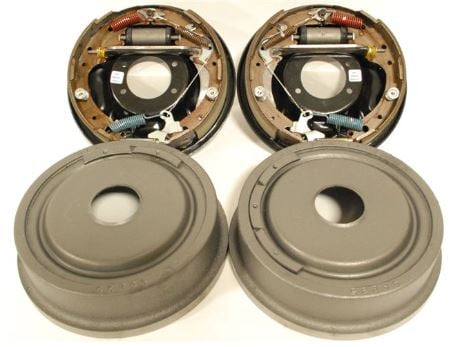
Rear drum brakes were commonly used on vehicles until the late 1970s when disc brakes became the popular choice. Drum brakes consist of a cylinder (drum) that houses a set of brake shoes. When the brake pedal is depressed, hydraulic pressure forces the shoes outward against the drum. This contact creates friction, which slows down or stops the rotation of the drum and, ultimately, the vehicle.
Sign up now to join the JEGS email newsletter and be the first to learn about new products, special deals and e-mail only offers!
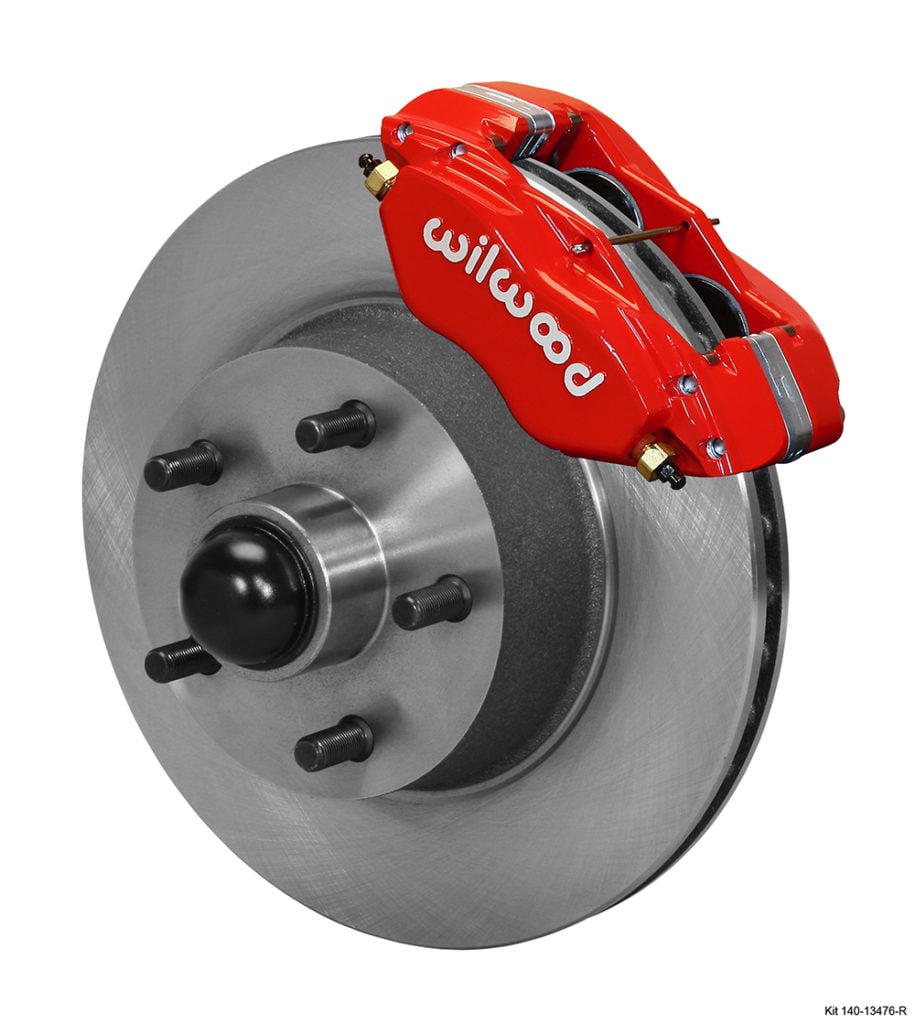
Disc brakes are the better option when it comes to stopping power and fade resistance. A disc brake system consists of a rotor (disc), caliper, and pads. When the brake pedal is depressed, hydraulic pressure forces the caliper pistons to push the pads against the rotor. This contact creates friction, which slows down or stops the vehicle much quicker than drum brakes.
There are a few different factors to consider when deciding whether or not to convert your rear drum brakes to disc brakes. The most important thing to keep in mind is safety. Disc brakes offer superior stopping power and are less likely to fade. If you do a lot of driving in stop-and-go traffic or live in an area with hilly terrain, disc brakes are a must.
Another consideration is cost. A classic car disc brake conversion kit can be expensive, but when talking about safety, there's no putting a price tag on that. If you're handy with tools and are comfortable working on your vehicle, you can save some money by purchasing the individual components needed for the conversion and installing them yourself.
With a little research and determination, converting your rear drum brakes to disc brakes is a relatively easy process. If you purchase a complete kit, all of the necessary components and instructions will be included.
Either way, you'll need to start by removing the rear drums, brake shoes, backing plates, and all associated hardware. Pro tip: spray each nut and bolt with penetrating fluid before attempting to remove them. This will help to loosen any rust or corrosion that may have built up over time.
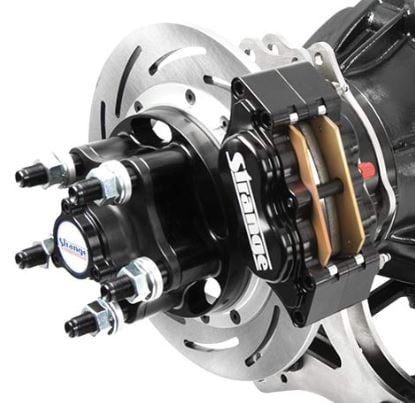
Once the drums and shoes are removed, you'll need to clean up the area and make any necessary repairs, like replacing rusted-out hardware. The next step is to install the new disc brakes. If you're using a kit, follow the included instructions. In many cases, the axles will need to be removed from the rear differential housing in order to install the caliper mounting brackets. If you're piecing the system together yourself, be sure to consult a professional or reference a reliable source for guidance.
With so many kits and components on the market, choosing the right one for your vehicle can be a challenge. Luckily JEGS experts are here to help. Give us a call or visit us online for assistance finding the perfect disc brake conversion kit for your application.

i have a 64 Nova 400 wagon, that came with a 283, & Muncie 4spd. the original engine is rebuilt & now a 302, with performance components, as well as a new Holley 750.( around 400hp ) i have a CPP front suspension with disc brakes, but the rears are still drum. i have it taken apart as i am installing an Eaton Posi unit in the diff., and while im at this point, i might as well change the rears to disc brakes. i am having a really hard time finding just a rear conversion set/kit, for my year ( 64 ). i have a 10 bolt, with unfortunately 4.5″ lug spacings. i do have rims with 4.75 lug holes( both ), so i could keep the 4.5 axles, however, i am not averse to buying new 4.75 lug axles, if i have to. i would prefer to find 2 piston calipers for this conversion, but cannot find this either. ALSO, my biggest concern is, if this conversion will change the hub location ( outward), as my current tire/wheel set just barely fits without rubbing/fender interference ( 15×8 chrome Rallys with 225/70-15’s ). other question i have not been successful at finding, do i need another Master, or just add a proportioning valve ? this car is in exceptional condition inside & out, Cali car, NO rust, etc.

Hi Tony, you’re absolutely on the right track doing the rear disc conversion while the rear end is apart. Since you’re working with a 1964 Nova running a 10-bolt with 4.5-inch lug spacing, that’s where things get tricky as most of the off-the-shelf rear disc kits for early Novas are made for the later 8.2-inch or 8.5-inch 10-bolts with 4.75 pattern.
Companies like Wilwood, Right Stuff Detailing, and others make universal and custom-fit rear disc brake conversion kits that can be adapted to your setup. You can use a universal GM 10-bolt rear disc conversion kit from Wilwood or Right Stuff, but to do that you’ll need to confirm your axle flange offset and bolt pattern. If you decide to swap to 4.75 axles, that opens the door to direct-fit kits for early Novas, which will give you a much cleaner installation and a better selection of two-piston caliper options.
Regarding clearance, most rear disc conversions add about ⅛ to ¼ inch per side, depending on the rotor hat thickness and bracket design. That’s usually manageable, but with your tight fitment, it’s definitely something to measure for before you commit. A good trick is to mock up the wheel on the bare axle flange with a straightedge to see how much room you have to spare inward and outward.
As for the master cylinder and proportioning valve, since you already have a front disc/rear drum setup, you’ll want to switch to a disc/disc master cylinder. A proportioning valve (either adjustable or matched disc/disc combo valve) will help fine-tune the bias and prevent premature rear lockup.
If you’d like help matching the correct Wilwood or Right Stuff rear disc kit based on your housing flange and wheel pattern, give us a call at 1-800-345-4545 and one of our tech specialists can confirm what will fit your setup and keep that wheel clearance right where you need it.

Bonjour je voudrais savoir le prix pour un kit complet de conversion de frein tambour arrière en frein a disque sur une renault laguna 1 phase 2 1.6l 16v essence immatriculation CP-477-WA
Bonjour, merci pour votre question. Malheureusement, nous ne proposons pas de kit complet de conversion de frein tambour arrière en frein à disque pour la Renault Laguna 1 Phase 2 1.6L 16v. Nous vous recommandons de contacter un spécialiste Renault ou un fournisseur de pièces en Europe pour vérifier la disponibilité.
Hello, thank you for your question. Unfortunately, we do not offer a complete rear drum-to-disc brake conversion kit for the Renault Laguna 1 Phase 2 1.6L 16v. We recommend checking with a local Renault specialist or European parts supplier for availability.

Hi,
I have mazda 2 de 2014 that is umpossible to source a kit for. What would be the closest match in terms of a kit for the car ? If there isnt one recommend individual components.
Thank you,
Alex
Alex,
You are running into that problem because there really is no direct bolt on rear disc conversion kit for the Mazda 2 DE chassis. That car uses an integrated rear drum and hub design with the parking brake built into the drum, plus ABS and stability control that are very sensitive to changes. Because of that, there is not a closest matching kit that can be safely adapted from another vehicle without custom fabrication. Converting it properly would require custom caliper brackets, matching rear hubs, rotors with the correct offset, compatible calipers, custom parking brake solution, revised brake hoses, and careful attention to ABS sensor placement and tone rings. At that point it becomes a full custom brake job rather than a conversion kit, and it can quickly cost more than the car is worth while also introducing safety and inspection issues. For street use, the most reliable and accurate upgrade path is refreshing the factory rear drums with quality components and pairing that with better front brakes, higher quality pads and rotors, stainless brake hoses, and fresh fluid, which will give you a noticeable improvement in braking balance and pedal feel without upsetting the ABS system. If you are building the car strictly for motorsports or are comfortable with custom fabrication, the exact parts selection would depend on your rear hub dimensions, rotor offset, parking brake strategy, and ABS configuration, which would need to be measured before anything could be recommended with confidence. For help walking through realistic upgrade options that make sense for your Mazda 2, you can call 1-800-345-4545 and speak with a tech specialist who can help you plan the safest and most cost effective approach.




Leave a Reply